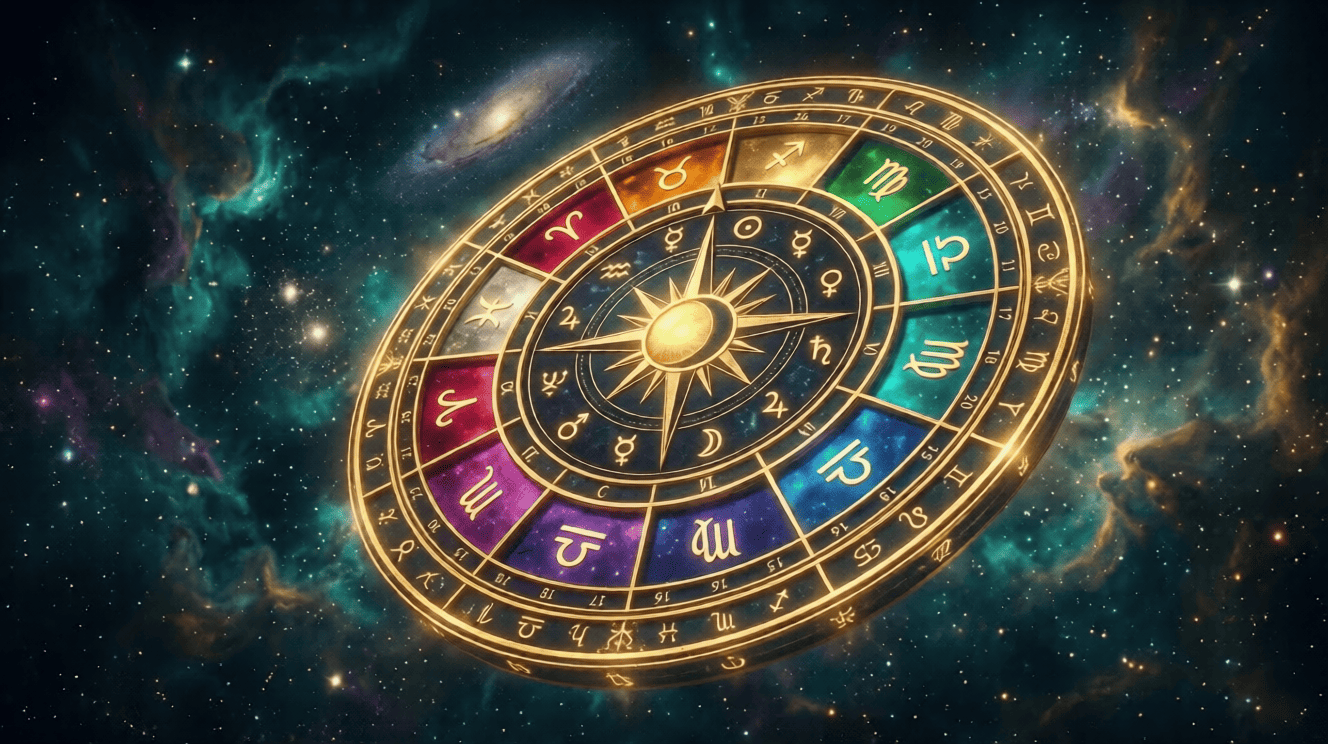
What a Birth Chart Actually Is
A birth chart — also called a natal chart — is a map of the sky at the exact moment you were born, from the perspective of the exact place you were born. It shows where every planet in our solar system was positioned at that moment, which sign of the zodiac each planet occupied, and which of the twelve astrological houses each planet fell into.
The chart is circular because it represents the full 360-degree sky around the point of your birth. The inner wheel is divided into twelve houses, which represent twelve areas of life. The outer ring shows the zodiac — the twelve signs. The planets are placed inside the wheel according to where they actually were in the sky when you arrived.
To generate your birth chart, you need three things: your date of birth, your time of birth, and the city where you were born. The time is the part most people are hazy on — it's worth checking your birth certificate, because even an hour's difference can shift your rising sign and house positions significantly. If you genuinely cannot find your birth time, a chart can still be calculated without it, but the rising sign and houses will be unavailable.
Start Here: The Big Three
If you've ever read about astrology at all, you'll have encountered the concept of your "Big Three" — your Sun sign, Moon sign, and Rising sign. These three placements are the foundation of your chart and the most immediately meaningful place to start.
Your Sun sign is what most people mean when they say "I'm a Scorpio" or "I'm a Taurus." It's determined by where the Sun was when you were born. In astrological tradition, the Sun represents your core identity — your conscious sense of self, the version of you that you're actively building over a lifetime. It describes who you are when you're fully expressed, not who you are when you're stressed or hiding.
Your Moon sign is where the Moon was at your birth — and since the Moon moves through all twelve signs every 28 days, your Moon sign is far less predictable than your Sun sign. The Moon in astrology governs your emotional inner life: your instinctive reactions, what makes you feel safe, what you need from close relationships, and the part of yourself you don't always show to the world. Many people feel their Moon sign describes them more accurately than their Sun sign, particularly in emotional or private contexts.
Your Rising sign (also called the Ascendant) is the zodiac sign that was just coming up over the eastern horizon at the exact moment of your birth. It changes roughly every two hours, which is why birth time matters so much. The Rising sign governs the mask you present to the world — first impressions, your physical appearance, your instinctive social approach, and the lens through which you perceive and engage with life. It's often what other people notice about you before they really know you.
The Planets: What Each One Governs
Once you've found your Big Three, you can begin to explore the other planets. Each planet governs a different area of life and psychological function. In your chart, each planet is in a sign (which colours how it operates) and a house (which tells you which area of life it operates in).
Mercury governs your mind — how you think, communicate, process information, and learn. Venus governs love, beauty, pleasure, and money. Mars governs drive, desire, action, and conflict. Jupiter governs expansion, luck, philosophy, and growth. Saturn governs structure, discipline, responsibility, and the lessons life insists you learn. Uranus governs disruption, innovation, and sudden change. Neptune governs dreams, illusions, spirituality, and the dissolution of boundaries. Pluto governs transformation, power, death and rebirth.
When you read that your Venus is in Gemini, for example, that means the planet governing love and pleasure was in the sign of Gemini when you were born — and Gemini brings its qualities (curiosity, wit, variety, restlessness) to how you experience love and what you find beautiful.
The Houses: The Twelve Areas of Life
The twelve houses divide the chart into twelve areas of lived experience. The first house begins at your Rising sign and governs the self. The second governs money and possessions. The third governs communication, siblings, and local travel. The fourth governs home, family, and roots. The fifth governs creativity, romance, and children. The sixth governs health, daily routines, and work. The seventh governs partnerships — both romantic and business. The eighth governs shared resources, sex, death, and transformation. The ninth governs philosophy, higher education, and long-distance travel. The tenth governs career and public reputation. The eleventh governs friendships, communities, and hopes. The twelfth governs the unconscious, secrets, and what is hidden.
When you have several planets in one house, that area of life tends to be particularly active, complex, or significant in your experience.
How to Actually Read It
The most common mistake people make when first reading their chart is trying to interpret every placement independently, as if each one is a separate fact. A chart isn't a list — it's a web. Every placement interacts with every other placement, and the aspects (the geometric angles between planets) create a picture that is far more nuanced than any individual feature.
A practical starting point: pull up your chart (astro.com is the most comprehensive free option), find your Big Three, and spend a week just sitting with those three placements. Read about each one separately. Notice when you recognise yourself, and notice when you don't — both are useful information. Disagreement with your chart is not evidence that astrology doesn't work; it's often evidence that you're only seeing one layer of yourself.
After the Big Three, look at where Saturn sits. Saturn shows where you face your biggest challenges and your most important growth — and it rarely goes where you wish it would. Then look at Venus and Mars together, since the relationship between those two says a lot about how you navigate attraction and desire.
The rest reveals itself with time. A birth chart is not a document you read once and put away. It's a reference point you return to throughout your life, and it tends to become more legible — and more eerily accurate — the longer you live inside it.