How Synastry Works
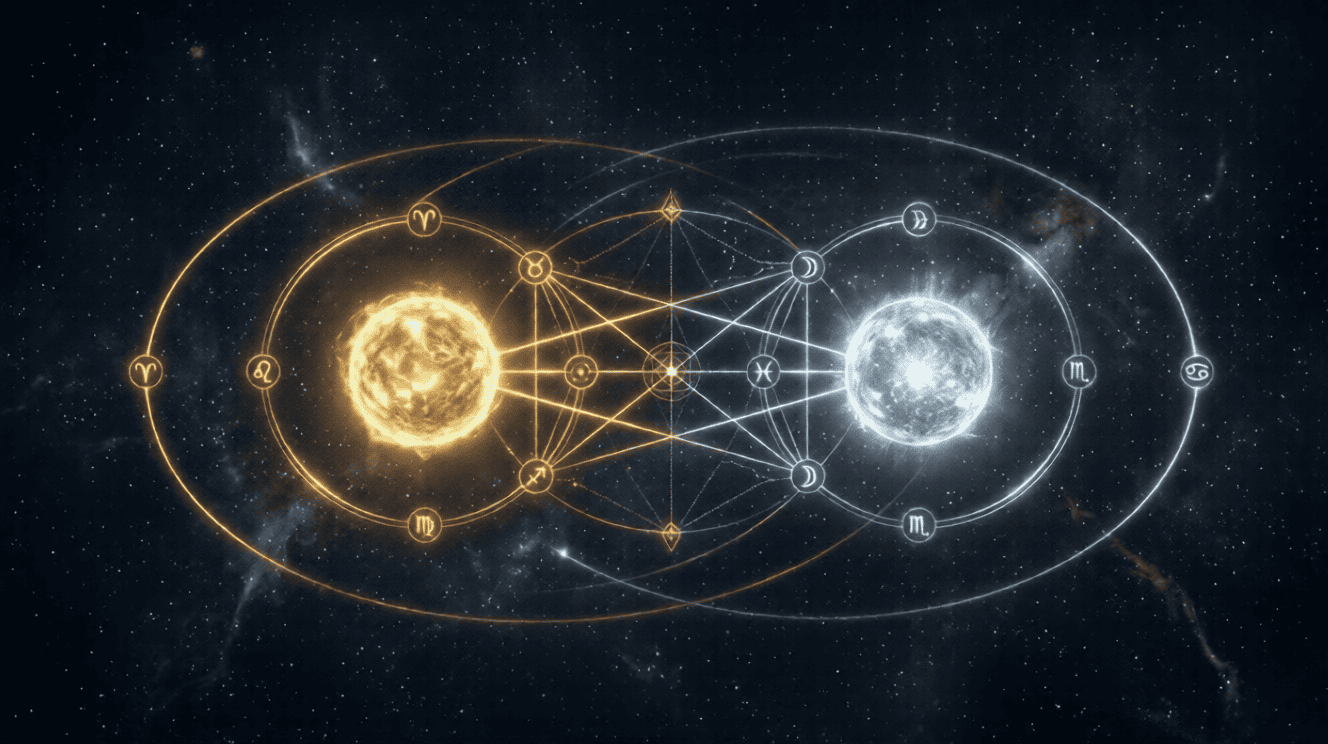
In synastry, you take two birth charts and look at how the planets in one person's chart interact with the planets in the other person's chart. When one person's planet falls on (or in aspect to) another person's planet, it activates the themes of both planets simultaneously in the relationship.
A synastry chart is typically represented as a bi-wheel: one person's chart in the inner wheel, the other's in the outer ring. The aspects between planets across the two charts are what you read.
The Most Important Connections
Sun-Moon aspects are the cornerstone of synastry compatibility. When one person's Sun contacts the other's Moon, there is a fundamental resonance between their core identity and their emotional needs. Sun conjunct Moon (the Sun and Moon in the same sign and degree across two charts) is one of the most powerful compatibility indicators — it tends to produce a sense of being genuinely met and understood. Sun-Moon squares and oppositions still create significant magnetic pull but with more friction and potential for misunderstanding.
Venus-Mars aspects describe romantic and sexual attraction. When one person's Venus contacts the other's Mars, there is often undeniable chemistry — a push-pull dynamic that can be electric. Conjunction, trine and sextile aspects here tend to feel easy and pleasurable; squares and oppositions are more intense and can involve frustration alongside the attraction.
Moon-Moon aspects describe emotional compatibility — how two people's inner worlds resonate or clash. A trine or sextile between two Moons suggests emotional attunement; a square can mean that what each person needs emotionally feels to some degree like it comes at the other's expense. This is one of the most important connections to check in any close relationship.
Saturn contacts are perhaps the most sobering but also among the most meaningful connections in synastry. When someone's Saturn touches your personal planets (Sun, Moon, Venus, Mars), it brings seriousness, structure and a sense that this person somehow defines you or holds you to account. Conjunctions feel heavy but often binding. These contacts are common in long-term relationships because Saturn's steadying influence holds things together through difficulty — but if Saturn also suppresses or limits, the weight becomes oppressive over time.
Pluto contacts indicate transformative, intense connections. When someone's Pluto contacts your Sun or Moon, they reach into your depths in ways you can't easily resist. These connections are rarely comfortable, but they tend to change you. Relationships with strong Pluto synastry often feel fated or compulsive and can be profoundly significant even when they are not ultimately sustainable.
North Node Contacts
When one person's planets contact the other's North Node, the relationship tends to feel karmic or meaningful in a way that's hard to articulate — as if meeting this person is moving you in a direction you're supposed to go, even when the relationship itself is difficult. These connections are extremely common in relationships that are described as life-changing, whether or not they last.
What Synastry Cannot Tell You
Synastry shows potential, not outcome. Two people with challenging synastry can build a functional, loving relationship through commitment and communication. Two people with textbook synastry compatibility can have a deeply dysfunctional relationship if neither of them has done any personal work.
The most accurate predictor of relationship success isn't synastry — it's whether both people are capable of honesty, repair and the willingness to grow. Synastry tells you the flavour of a connection and where the pressure points are; what you do with that information is up to you.