Where Tarot Actually Comes From
The history of tarot is not what most people expect. The earliest surviving tarot decks — the Visconti-Sforza decks of 15th century northern Italy — were expensive luxury playing cards made for the nobility. The game they were used for, tarocchi, was not unlike modern trick-taking card games. There was nothing mystical about them.
It was not until the 18th century that French occultists, particularly Antoine Court de Gébelin, began claiming that tarot was an ancient Egyptian wisdom tradition — a claim that was entirely fabricated but proved extraordinarily influential. By the late 1700s, tarot had become firmly embedded in esoteric practice across Europe.
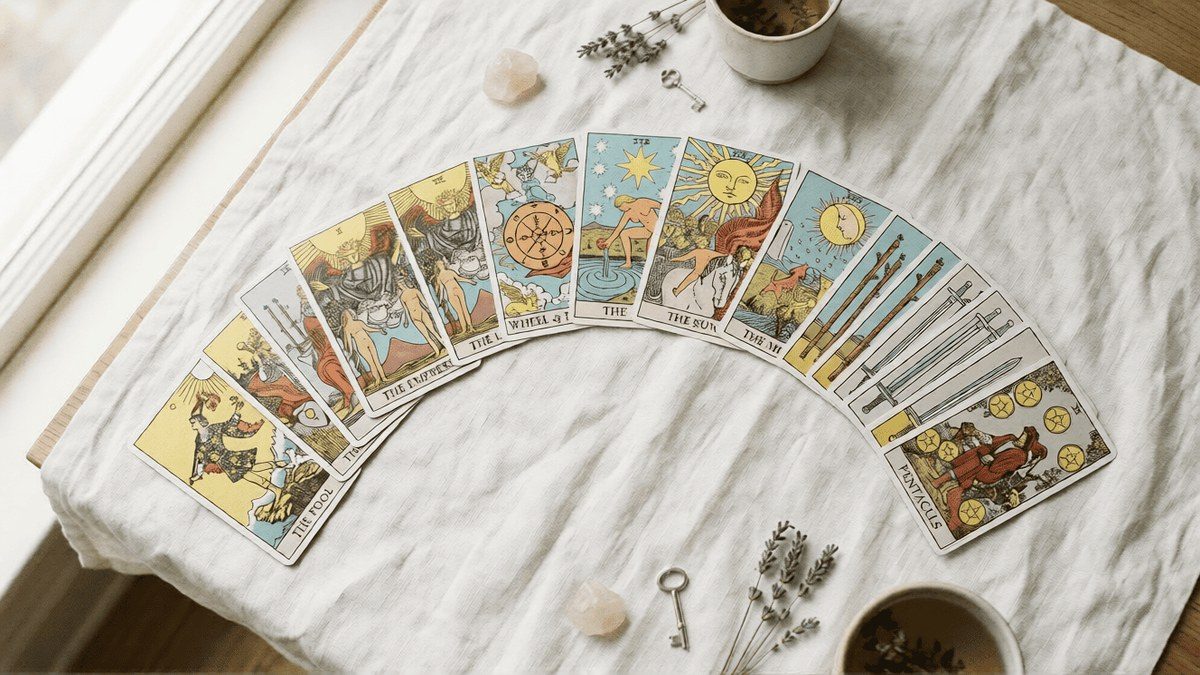
The deck most people learn on today — the Rider-Waite-Smith deck — was published in 1909. It was designed by occultist Arthur Edward Waite and illustrated by Pamela Colman Smith, who deserves far more credit than she typically receives. Smith's innovation was to illustrate not just the court cards and major arcana, but every single one of the 56 minor arcana cards with fully rendered scenes. This made the deck far more accessible to intuitive reading and is the reason the Rider-Waite-Smith format became the template for virtually every tarot deck published since.
The Structure of the Deck
A standard tarot deck contains exactly 78 cards, divided into two groups with very different characters.
The Major Arcana: 22 Cards
The Major Arcana run from card 0 (The Fool) to card 21 (The World). These are the heavy-hitting cards — the ones that deal with major life themes, significant turning points, and deep archetypal energies. When a Major Arcana card appears in a reading, it signals that the matter in question carries real weight. These are not everyday concerns; they are life themes.
Together, the 22 Major Arcana tell a complete story called the Fool's Journey — a symbolic narrative of a soul moving through life from innocent beginning to wise completion. The Fool starts with nothing but trust and curiosity. The Magician shows him how to use his tools. The High Priestess teaches him to listen inward. The Empress connects him to abundance and the natural world. And so it continues, through challenge and breakthrough, until The World brings full integration. Every human life maps somewhere onto this sequence.
The Minor Arcana: 56 Cards
The Minor Arcana deal with the texture of everyday life — not grand destiny, but the choices, relationships, emotions, and practical concerns that fill the days. They are divided into four suits of 14 cards each: Ace through Ten, plus four court cards (Page, Knight, Queen, King).
Wands (Fire): The suit of energy, ambition, creativity and career. When Wands dominate a reading, the question is about what you want to create and whether you have the drive to pursue it. The shadow side of Wands is scattered energy, impulsive decisions, and burning out before the goal is reached.
Cups (Water): The suit of emotion, intuition, relationships and dreams. Cups deal with how you feel rather than what you think, with the quality of your inner life and your connections to others. A reading full of Cups is asking you to pay attention to your emotional reality.
Swords (Air): The suit of thought, communication, conflict and truth. Swords are the most challenging suit — they deal honestly with difficulty, loss, and the mental suffering that comes from worry, regret, or self-deception. They also represent clarity, intelligence, and the courage to cut through confusion with honest thinking.
Pentacles (Earth): The suit of the material world — money, work, health, and the physical environment. Pentacles are concerned with what is real and tangible. They reward patience, consistency, and careful attention to the practical details of daily life.
The Court Cards
The court cards — Pages, Knights, Queens, and Kings — are the most confusing element of the deck for beginners, and with good reason. They can represent actual people in your life, aspects of your own personality, or energies you need to embody or encounter. Context is everything.
Pages are learners and messengers — the energy of beginning something new with fresh eyes. Knights are in motion — the energy of pursuit, sometimes excessive in its single-mindedness. Queens have mastered their suit's emotional landscape and tend to work internally and subtly. Kings have mastered their suit's external expression and tend to represent authority, achievement, and the mature exercise of power.
Doing Your First Reading
The single most important thing to understand before doing your first reading is this: you are not trying to predict a fixed future. You are creating a map of where your energy currently stands and what might unfold if you continue on this trajectory. The point is reflection, not fortune-telling.
Start with a three-card spread. Shuffle your deck while holding a specific question in mind — not "what will happen?" but "what do I need to understand about this situation?" Draw three cards and lay them face down. The classic positions are: past (what has shaped this situation), present (where you currently stand), future (where current energy is heading if nothing changes).
Turn over each card and sit with it before reaching for a guidebook. What is your immediate, uncensored reaction to the imagery? What does the scene on the card remind you of in your own life? Your first instinct is usually the most personally relevant interpretation. The guidebook gives you the traditional meaning; your intuition gives you the personalised one. Good readings draw on both.
Building Real Intuition: The Daily Card Practice
The fastest way to learn tarot is not to memorise all 78 meanings at once — it is to draw one card each morning and spend the day looking for its themes in your experience. This builds the kind of embodied familiarity with each card that no amount of book study can replicate.
Draw your card, look at the image for a minute, and ask yourself: where might I encounter this energy today? In the evening, look at it again. Did the day reflect the card? How? Sometimes the connection is literal (you drew the Three of Cups and unexpectedly met up with old friends). Often it is more subtle — you drew the Hermit and found yourself needing to withdraw from a social situation to think clearly. Both count.
Common Mistakes Beginners Make
The first mistake is reading for the same question repeatedly. If you do not like the answer, drawing again until you get something better is not how this works. Draw once, sit with what you receive.
The second mistake is treating reversed (upside-down) cards as purely negative. Reversed cards can indicate a blocked or internalised energy, a need for reflection rather than action, or simply that the card's qualities are present but not fully expressed. They are rarely simply "the opposite" of the upright meaning.
The third mistake is over-relying on the guidebook. The guidebook is a starting point. Tarot is a living practice and your relationship with the cards will develop its own vocabulary over time.
Is Tarot Psychic or Psychological?
This question divides the tarot community more than almost any other. Those who come from a spiritual tradition often experience tarot as genuinely oracular — a system through which something beyond ordinary consciousness speaks. Those who come from a more secular background tend to view it as a sophisticated projective tool — a structured way of externalising and examining what the unconscious already knows.
The honest answer is that tarot works consistently across both frameworks, and the reason it works is probably not the same for everyone. What the cards reliably do is create a focused, slowed-down space for reflection — and in that space, whatever you need to see tends to surface. Whether that is the universe speaking or your own deep intelligence — it may be that this distinction matters less than the practice itself.
Pick up a deck. Start with one card a day. Trust what you notice. The rest follows.