What Aspects Are
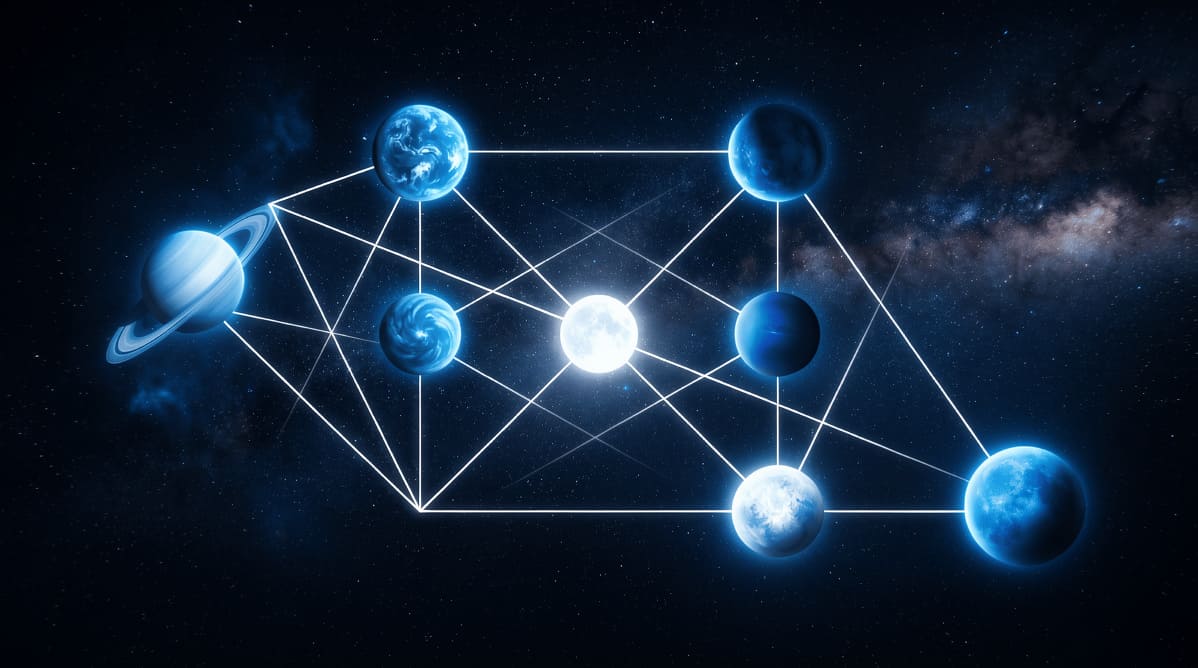
When two planets are a specific number of degrees apart in the zodiac, they form an aspect. The major aspects are based on simple geometric divisions of the 360-degree circle: the conjunction (0°), sextile (60°), square (90°), trine (120°), and opposition (180°). Each creates a different kind of dynamic between the two planets involved.
Aspects have an "orb" — the number of degrees of tolerance around the exact angle within which the aspect is considered active. Tighter orbs are more intense; wider orbs are more background. Most astrologers use an orb of around 8° for the major aspects between personal planets, tighter for outer planets.
The Conjunction (0°)
Two planets at the same point in the zodiac. A conjunction fuses the energies of both planets — they operate together, each intensifying and modifying the other. The nature of the conjunction depends entirely on which planets are involved. A Sun-Jupiter conjunction tends to be enthusiastic, expansive and fortunate. A Sun-Saturn conjunction can feel heavy, cautious and serious. A Mars-Pluto conjunction is intensely driven and potentially obsessive. Conjunctions are among the most powerful aspects in a chart because the energies are inseparable.
The Trine (120°)
Two planets 120° apart, typically in signs of the same element. The trine describes natural ease and flowing cooperation between the two planetary energies — the talents and abilities that come without significant effort. Trines are the aspects that indicate where things work well, where you're naturally gifted, and where energy flows with little resistance.
The potential pitfall of a trine is that its gifts are so easy to access that they can be taken for granted or never fully developed — there's no pressure to push them further. People often develop their squares more consciously than their trines precisely because the trines don't require effort.
The Square (90°)
Two planets 90° apart, typically in signs of the same mode (cardinal, fixed or mutable). The square describes tension between two planetary energies that are working at cross-purposes. This is the aspect that produces visible psychological tension, inner conflict and the kind of friction that forces growth.
Squares are not bad — they are generative. The tension they create tends to produce motivation, resilience and eventually a hard-won integration of the two energies that people with easy trines never develop. Many of the most driven and accomplished people have charts full of squares. The difficulty is real, but so is the potential that comes from having to work it through.
The Opposition (180°)
Two planets directly across the zodiac from each other. An opposition creates a polarity — two energies that are fundamentally different, pulling in opposite directions, asking to be held in balance simultaneously. The challenge with oppositions is that we tend to fully express one end of the polarity and project the other onto other people or external circumstances.
A Sun-Moon opposition, for example, can create a tension between the conscious identity (Sun) and the emotional needs (Moon) that expresses as recurring conflict between what you want and what you feel, or between your public role and your private needs. The integration is not to choose one side but to develop both and find a rhythm between them.
The Sextile (60°)
Two planets 60° apart, typically in signs of compatible elements. The sextile is a gentler version of the trine — two energies that cooperate and support each other, but with slightly more effort required to activate them. Sextiles describe opportunity — the potential is there, but it requires some initiative to access.
Reading Aspects Together
The most important thing about aspects is that they don't exist in isolation. A Venus that has a trine to Jupiter and a square to Saturn simultaneously is not simply "easy" or "difficult" — it experiences both the expansion and the limitation, and the interplay between them is what shapes the actual experience of Venus in that chart. Learning to read the full pattern of aspects around a planet rather than cherry-picking the comfortable ones is where chart reading becomes genuinely sophisticated.