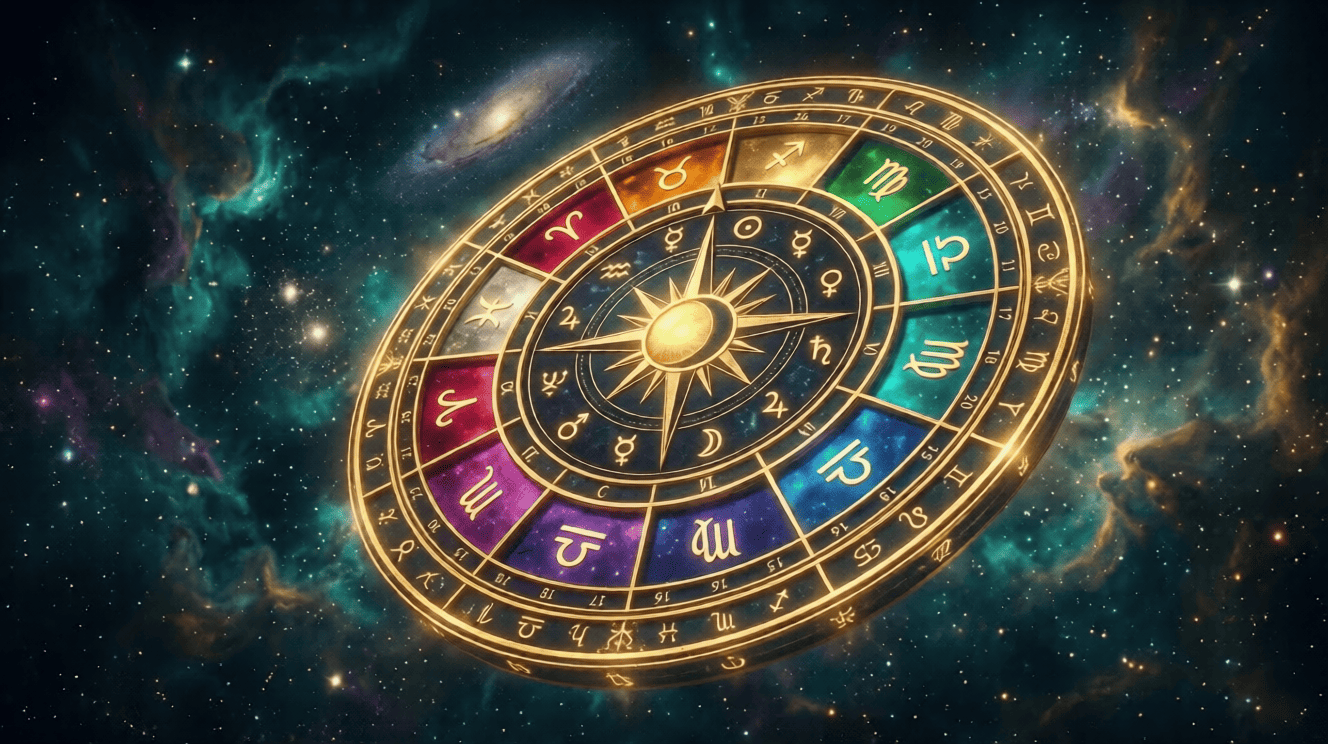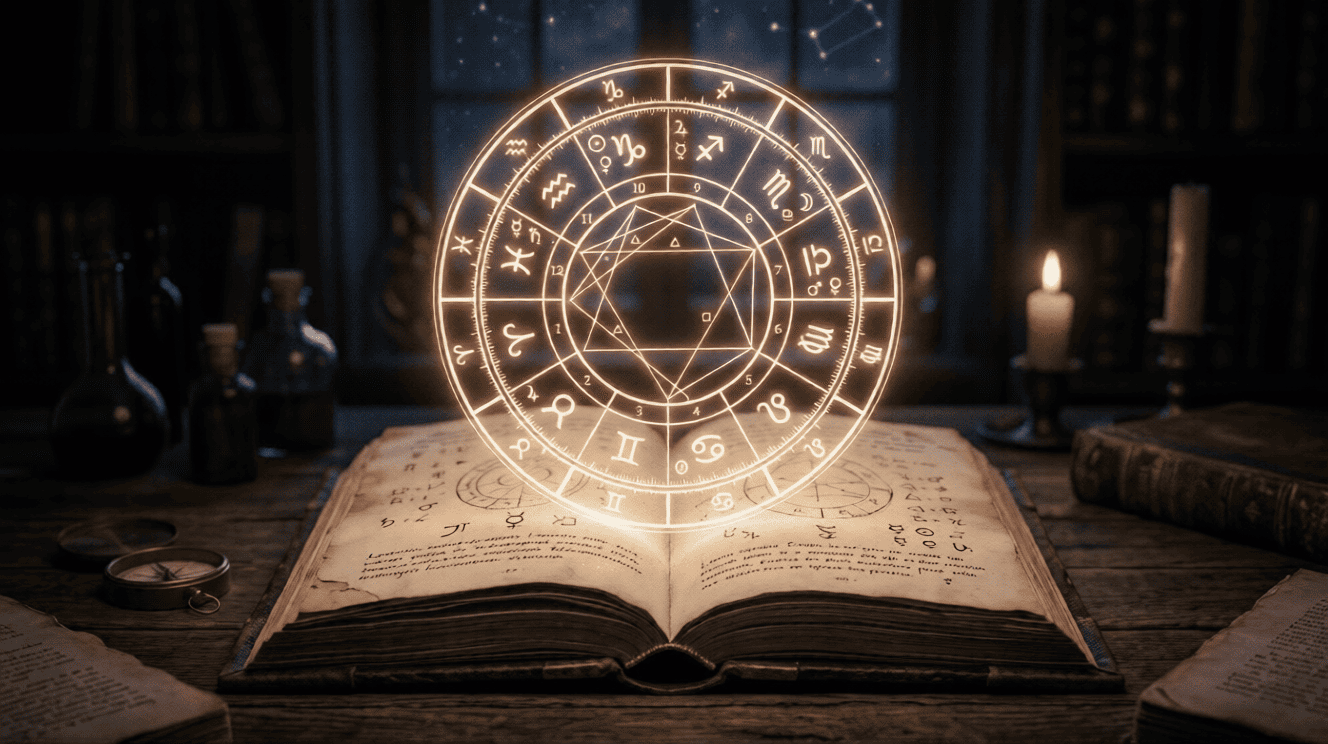
Step One: Pull Your Birth Chart
Go to astro.com and click "Free Horoscopes," then "Extended Chart Selection." Enter your date of birth, time of birth (as accurate as possible — check your birth certificate if you don't know), and place of birth. Select "Natal chart wheel" and generate the chart. You will see a circular diagram with symbols, lines, and numbers. Don't panic. You don't need to understand all of it at once.
The chart is a map of the sky at the exact moment you were born. The symbols represent planets. The twelve divisions of the circle represent houses (areas of life). The outer ring shows the zodiac signs. The lines across the middle represent aspects — angles between planets.
Step Two: Find Your Big Three
Your Sun sign, Moon sign and Rising sign (Ascendant) are the starting point. Most astrology sites will tell you these directly, or you can look them up in your chart data. The Sun sign is what most people mean when they ask "what's your sign." The Moon sign requires your date and city but not necessarily the exact time. The Rising sign requires a fairly accurate birth time — even an hour off can change it.
Your Sun sign describes your core identity and the direction of conscious self-development. Your Moon sign describes your emotional inner life and what you need to feel secure. Your Rising sign describes how you present to the world and the lens through which you perceive life. Together these three create a much more nuanced picture than the Sun sign alone.
Step Three: Understand the Elements
The twelve signs are divided into four elements: fire, earth, air and water. Aries, Leo and Sagittarius are fire — energetic, enthusiastic, action-oriented and sometimes impatient. Taurus, Virgo and Capricorn are earth — practical, reliable, grounded and sometimes inflexible. Gemini, Libra and Aquarius are air — intellectual, communicative, social and sometimes detached. Cancer, Scorpio and Pisces are water — emotional, intuitive, empathic and sometimes overwhelmed by feeling. Knowing the element of your Sun, Moon and Rising sign immediately tells you a lot about the overall texture of your personality.
Step Four: Understand the Modes
The signs are also divided by mode: cardinal, fixed and mutable. Cardinal signs (Aries, Cancer, Libra, Capricorn) initiate and begin. Fixed signs (Taurus, Leo, Scorpio, Aquarius) maintain and sustain. Mutable signs (Gemini, Virgo, Sagittarius, Pisces) adapt and transition. Your mode tells you something about your relationship to change and action: cardinals start things, fixed signs hold things, mutable signs shift and adjust.
Step Five: Learn the Planets
There are ten major bodies in a birth chart: the Sun, the Moon, and eight planets from Mercury to Pluto. Each one governs a specific domain of life and psychological function. Mercury: mind and communication. Venus: love and money. Mars: drive and desire. Jupiter: expansion and luck. Saturn: structure and limitation. Uranus: disruption and liberation. Neptune: spirituality and illusion. Pluto: transformation and power.
In your chart, each planet sits in a sign (which describes how it operates) and a house (which describes which area of life it operates in). A Mars in Scorpio in the 2nd house describes how you go after money and resources with Scorpionic intensity and depth — very different from a Mars in Gemini in the 9th house, which goes after philosophical and educational adventures with variety and wit.
Step Six: Don't Try to Know Everything at Once
The most common mistake beginners make is trying to learn the entire system at once. Astrology is genuinely large — it has been developed for thousands of years by many different cultures and traditions. You will not understand it in a weekend, and you don't need to.
The most effective approach is to pick one thing — your Moon sign, for example — and spend a week just observing whether it describes you accurately. Read about it, notice when you recognise yourself in it and when you don't. Then move to the next piece. After six months of this kind of attentive observation, you will know your own chart in a way that no amount of rapid studying produces.
Astrology reveals itself progressively. The more life experience you have, the more legible your chart becomes — because more of what it describes has had the chance to actually happen. The chart is a living document you return to over a lifetime, not a test you pass once and move on from.