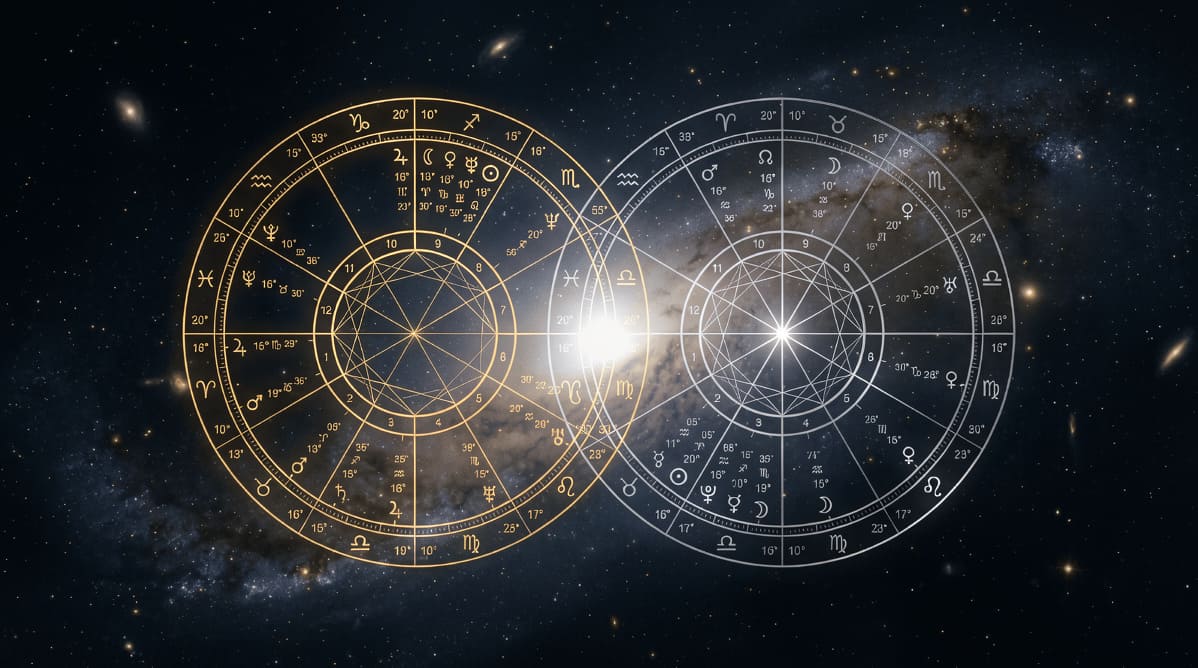
How the Composite Chart Is Calculated
The composite chart is calculated by finding the midpoints between the two people's corresponding planets. The composite Sun is the midpoint between Person A's Sun and Person B's Sun; the composite Moon is the midpoint between their two Moons; and so on for every planet. The result is a new chart that doesn't belong to either person individually but describes the combined energy they create together.
You can calculate a composite chart at astro.com by entering both birth dates and selecting "Composite Chart (Midpoint Method)" from the chart options.
The Composite Sun
The composite Sun describes the core purpose and direction of the relationship — what it is fundamentally for, what it is trying to accomplish, and where the two people are going together. A composite Sun in Sagittarius suggests a relationship oriented toward adventure, philosophical exploration and mutual growth through expanded horizons. A composite Sun in Capricorn suggests a relationship with serious practical purposes, oriented toward building something lasting.
The Composite Moon
The composite Moon describes the emotional home base of the relationship — how the two people feel when they're together, what their instinctive domestic rhythm is, and what they need from each other to feel emotionally secure in the connection. A composite Moon in Taurus suggests a relationship that feels most comfortable with stability, shared pleasures and consistent physical presence. A composite Moon in Gemini suggests a relationship where communication and variety are essential to emotional wellbeing.
Challenging Aspects in the Composite
Difficult aspects in a composite chart — particularly squares and oppositions involving the Sun, Moon or relationship-significant planets (Venus, Mars, the Ascendant) — describe the inherent tensions of the relationship. These are not signs to avoid the relationship; they are descriptions of the friction that is built into its structure and must be consciously worked with.
A composite Sun square Saturn describes a relationship with built-in restriction — something that requires real commitment and discipline to sustain but that can produce extraordinary durability if both people are willing to do that work. A composite Venus opposition Neptune can describe a relationship with enormous romantic idealism that occasionally collides with reality, requiring both people to see each other clearly rather than through an idealised lens.
The Composite vs Synastry
Both tools are useful and they describe different things. Synastry tells you how you affect each other — where Person A's presence lights Person B up, where Person B's Saturn presses on Person A's Moon. The composite tells you what the relationship is as its own thing — what it is for, where it wants to go, what it needs to thrive.
The most complete picture comes from looking at both. Synastry shows the dynamic between the individuals; the composite shows the nature and purpose of the entity they create together. Long-term partners who are interested in understanding their relationship deeply often find the composite chart extraordinarily illuminating — not for predicting whether the relationship will work, but for understanding what it is actually asking of them.